Aug 17, 2026Shreyas Sen11 min read
The Internet Has Provenance. Physical AI Needs Physical Context.
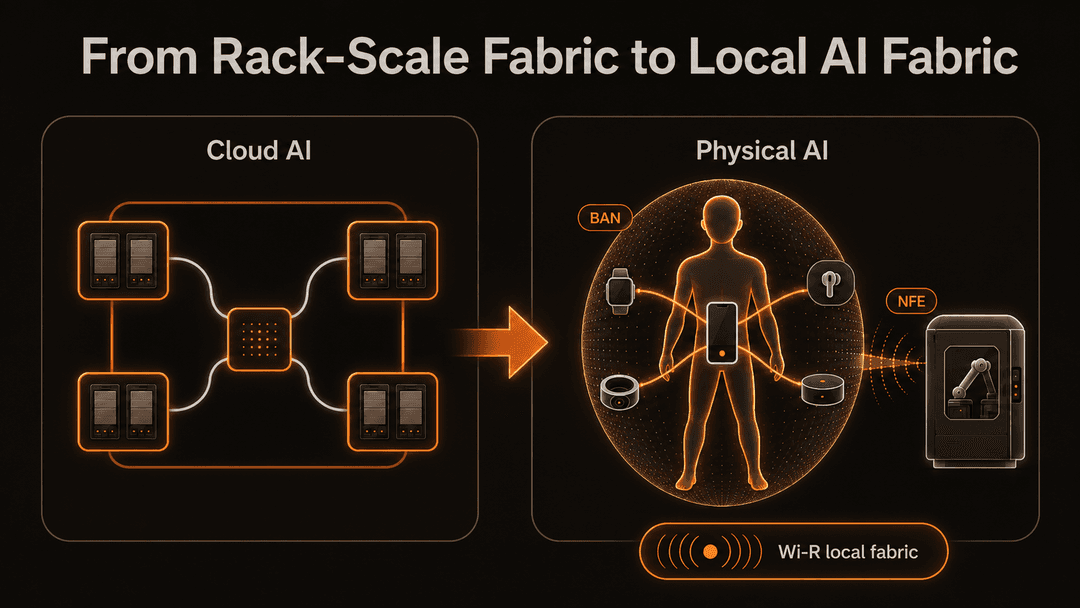
The internet is starting to mark how digital content was made. Physical AI also needs signals about how people, devices, and machines relate in the physical world.
The internet is starting to mark how digital content was made. Physical AI also needs signals about how people, devices, and machines relate in the physical world.
In August 2026, Anthropic announced that future Claude models will add an invisible statistical watermark to generated text. Anthropic plans to apply the watermark globally at launch. Supported files will also carry signed Content Credentials from the Coalition for Content Provenance and Authenticity, or C2PA. The announcement followed the start of Article 50 transparency duties under the EU AI Act [1][2].
This is an important shift. The internet is starting to carry evidence about how digital content was made.
Anthropic also states a clear limit. Its watermark can show only that Claude was likely involved. It cannot distinguish original generation from heavy editing [1].
Watermarking and provenance answer questions about files. They do not explain how people, devices, and machines relate in the physical world.
AI is moving from files into physical systems. Physical AI senses and acts through physical devices. It is entering glasses, wearables, robots, tools, vehicles, and medical systems.
These systems need more than digital provenance. They need physical context.
The web made digital identity essential. Mobile made location essential. Generative AI is making provenance essential. Physical AI will make physical context essential.
Consider a person who wears AI glasses, earbuds, a watch, a ring, and two sensor patches. Software sees six devices and several wireless links. The wearer sees one physical system.
The network must understand more than device addresses. It must also understand how each device relates to the wearer, nearby devices, and the current task.
With this context, the devices can share sensing, compute, and control as one worn system. They do not need to operate as six independent wireless products.
I call this missing infrastructure the physical context layer.
Provenance tells us about the file
C2PA Content Credentials can record the origin and change history of a digital asset. They can describe which system created a file, which tools changed it, and whether the provenance changed later [3].
C2PA also states an important limit. Provenance alone cannot show whether digital content is true, accurate, or factual [3].
A real camera can record a staged scene. A signed work record can exist when no worker stood near the machine. An authenticated phone can remain in a room after its owner leaves.
Digital systems can increasingly answer questions about identity, time, location, and origin. They remain weak at another question:
What physical relationship supported the digital action?
The missing layer is physical context
The physical context layer gives software limited, defined signals about how people, devices, and machines relate in the physical world.
A product can use these signals to ask narrow questions:
- Is a wearable body-coupled, or is the device only nearby?
- Did two devices complete a deliberate local interaction?
- Do several devices form one worn or machine system?
- Did communication use a body-coupled path or a local device-to-device path?
- What physical relationship supports a digital claim?
Physical context is not the same as identity. It is not the same as location. It is not a universal proof of truth.
Physical context is a set of physical signals. A product can use these signals with its identity, security, and privacy systems.
Each signal must state what the system measured. The product must not claim more than the signal supports.
Each system answers a different question
| System or signal | Question it answers |
|---|---|
| Digital identity | Which account, credential, or device key participated? |
| C2PA provenance [3] | How was the digital asset created or changed? |
| Bluetooth Channel Sounding or UWB [4][5] | How far apart are the devices? |
| NFC [6] | Did the devices complete a deliberate tap-range exchange? |
| Wi-R BAN [7][8] | Did communication use a body-coupled path? |
| Wi-R NFE [9] | Did nearby devices complete a localized electric-field exchange? |
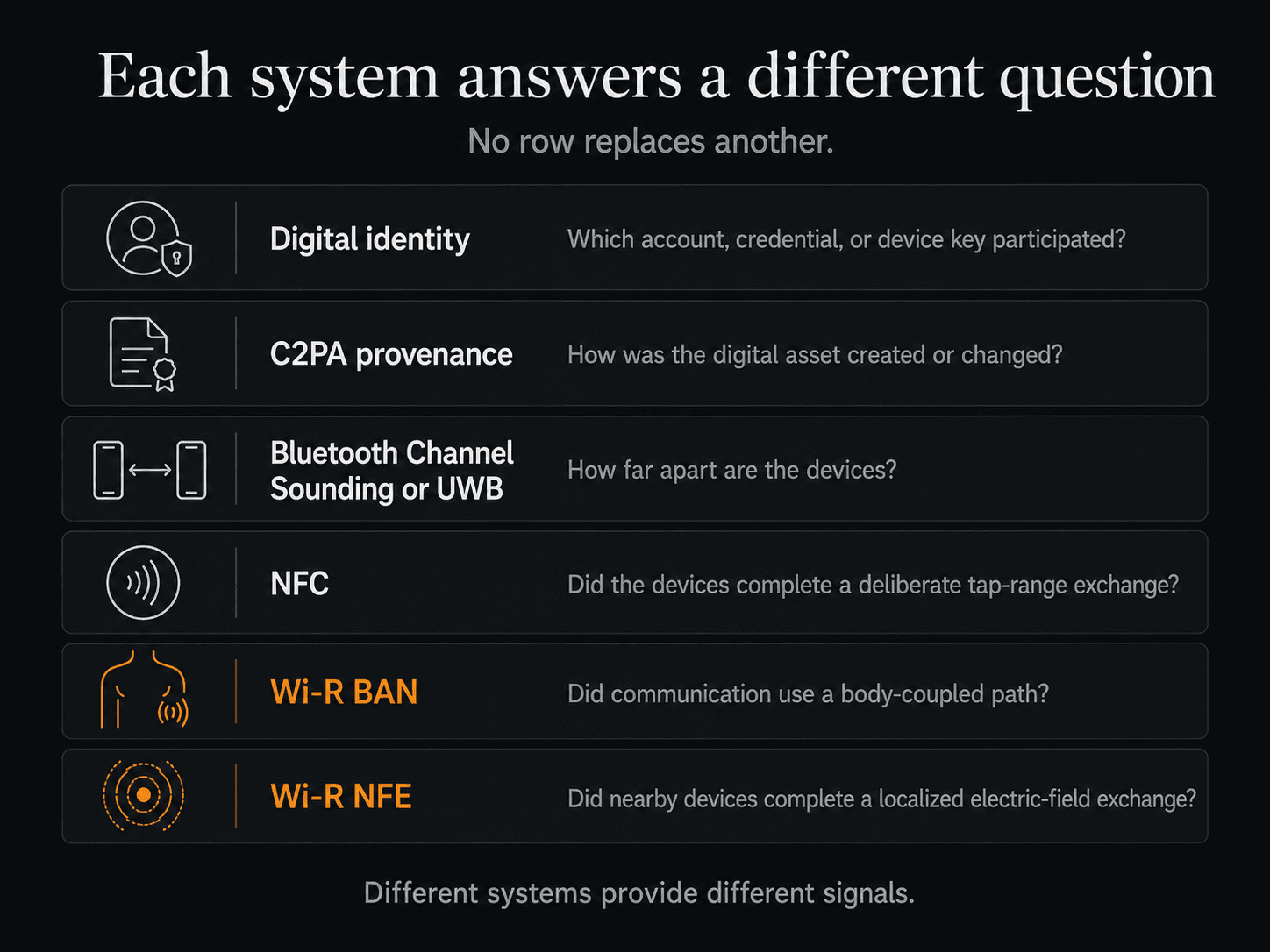
Identity identifies an account or credential. Provenance describes a digital asset. Ranging describes device geometry. A tap records a deliberate local interaction.
The physical context layer makes these boundaries clear. It also adds signals that current systems do not usually provide.
Current networks see devices, not physical relationships
Most communication systems report a simple result: device A exchanged data with device B.
They do not usually explain how the devices were physically related.
A link can include the body surface. It can remain within a few centimeters. It can connect several devices that belong to one worn system. It can connect modules that belong to one machine.
This information matters when software must sense and act in the physical world.
Physical AI needs networks that understand the system around the link, not only the addresses at its ends.
Connectivity can become a source of context
Connectivity has traditionally been judged by range, speed, reliability, and power.
Physical AI adds another criterion:
What does the link reveal about the physical relationship between its endpoints?
Wi-R uses localized electric fields for communication.
Wi-R Body Area Network, or Wi-R BAN, supports communication through a body-coupled path. The wearer's body surface forms part of that path [7].
Consider a wrist device and a phone that both include Wi-R. When the person holds the phone, the devices can exchange data through a body-coupled path.
The product team must characterize this geometry. After characterization, the live link can support a narrow inference: the phone and wrist device use the same body-coupled path, not only ordinary wireless proximity.
This signal does not identify the wearer. The product must use separate identity and security controls when identity matters.
Wi-R Near Field Electric, or Wi-R NFE, supports a localized electric-field link between nearby devices. It is designed for deliberate local interactions without room-scale broadcast [9].
YR23 supports data rates from 100 kbit/s to 5 Mbit/s. Ixana publishes link latency below 1 ms and energy of 0.2 nJ/bit at 5 Mbit/s [8].
XA-NFE3001 supports up to 20 Mbit/s. Ixana publishes link latency below 1 ms and energy of 0.12 nJ/bit at 20 Mbit/s in low-power mode. Its listed range is 1 to 25 cm. Ixana also lists extension to 1 m at lower data rates [9][10].
Final performance depends on the product geometry and operating conditions. The product pages contain the current specifications and integration information [8][9].
The communication link is no longer only a data path. The link can also provide a signal about physical context.
Proof of presence is the first visible use case
Consider a group photograph from a live event.
Provenance can show how the image was created and edited. Provenance cannot show that every named person was physically present.
Device ranging can show that two devices were close. Ranging does not show that a wearable used a body-coupled path. An authenticated account also does not show how the device related to the person who carried it.
A body-coupled signal can add information about the relationship between a wearable and a personal device. A localized link can add information about a deliberate interaction between nearby devices.
Each signal remains limited. A product must use each signal only for the question that it answers.
The same gap appears in other markets.
A field system can have an authentic work record without clear physical context around the worker and machine. A care system can identify a provider without showing that an in-person interaction occurred. An access system can validate an account without knowing how the device related to the person who carried it.
Proof of presence is one early use of the physical context layer.
The larger category is the ability to make defined physical relationships available to software.
The category is larger than presence
Tomorrow's wearable computer will not be one device.
It will include glasses, earbuds, watches, rings, patches, phones, and other sensors. These devices must share data and coordinate compute as one worn system.
Robots have a similar architecture problem. Sensors, actuators, hands, tools, and compute modules are distributed across moving parts. These modules must operate as one physical system, not as unrelated radios.
Machines also contain sealed modules, moving parts, and service points. A localized link can remove an exposed connector or service port. It can transfer data without broadcasting across the room.
Care systems can use local physical context without continuous location tracking. Field systems can support deliberate local interactions around people, tools, and machines.
Once networks can expose physical relationships, product architecture can change. Devices can coordinate sensing, data, and compute around the physical system that they serve.
This is not one feature for one market. It is a new connectivity requirement for Physical AI.
Why now
New infrastructure categories emerge when three conditions arrive together:
- A visible problem.
- A practical technical building block.
- Proof that the building block can ship.
The problem is now visible. Generative AI made digital provenance urgent. Physical AI is making physical context urgent.
The technical building block is now practical. Localized electric-field links can provide body-coupled and near-field signals within small-device power budgets.
The silicon is available. Ixana lists YR23 Wi-R BAN and XA-NFE3001 Wi-R NFE as products in production. Development kits are available for both products [10][11].
At CES 2026, Ixana demonstrated a five-device wearable network for simulataneous coordinated context [12].
A physical signal is not a verdict
Physical context is powerful because it concerns people, machines, and real-world actions.
The same information can become invasive when a product collects more data than the task requires. A product should ask the narrowest physical question that solves the problem. It should keep data local when possible. It should avoid permanent association histories when they are not necessary.
A strong product states three things:
- What the system measured.
- What the measurement supports.
- What the measurement does not establish.
This discipline separates useful physical context from unsupported claims.
Ixana is building the link layer
I began this work at Purdue in 2016. My research team studied how electro-quasistatic fields could create a broadband communication path around the body. Ixana was founded to turn that research into silicon [13][14].
At Ixana, my team and I build the link layer. We do not build every identity system, media platform, robot, or care application.
We build the silicon that makes a new physical signal available.
Wi-R is not a software mode for a conventional radio. Wi-R uses different channel physics. The technology requires dedicated circuits, coupling structures, firmware, system design, and validation.
I believe connectivity will no longer be judged only by how far and how fast it transfers data.
Connectivity will also be judged by how well it helps systems understand physical relationships.
That is the physical context layer.
Wi-R is our contribution to it.
Tell us the physical relationship your product cannot measure
Some of the most valuable applications may be applications we have not considered.
Contact Ixana when your product must:
- Distinguish a body-coupled link from a device that is only nearby.
- Support a deliberate local interaction from touch range to approximately 1 m.
- Connect distributed devices across a body or within a machine.
- Transfer up to 5 Mbit/s with less than 1 ms link latency in a power-constrained device.
- Add physical context without continuous location tracking.
- Replace a cable, connector, or exposed service port with a localized link.
Send us a short description or a simple system diagram. Include the two endpoints and their form factors. Also include the required distance, data rate, power limit, and physical relationship that matters.
An Ixana engineer will determine whether Wi-R BAN, Wi-R NFE, or another technology is the correct fit.
We will also tell you when Wi-R is not the correct link.
You can also email hello@ixana.ai.
References
[1] Anthropic, “How Claude’s text watermark works”, 14 August 2026.
[2] European Commission, “Guidelines on transparency obligations for providers and deployers of AI systems”, 20 July 2026.
[3] Coalition for Content Provenance and Authenticity, “C2PA and Content Credentials Explainer, Version 2.4”.
[4] Bluetooth SIG, “Bluetooth Channel Sounding”.
[5] FiRa Consortium, “How UWB Works”.
[6] NFC Forum, “NFC Technology”.
[7] Ixana, “Wi-R BAN Technology”.
[8] Ixana, “Wi-R Body Area Network Chips”.
[9] Ixana, “Wi-R Near Field Electric Chips”.
[10] Ixana, “Wi-R Silicon Chips”.
[11] Ixana, “Wi-R Developer Kits”.
[13] Shreyas Sen, “Wi-R Technology White Paper”.
[14] Purdue University, “Purdue Ventures Invests in Wearable Communication Chip Company Ixana”.
Physical AIWi-R BANWi-R NFEProvenanceContext-aware computing

Shreyas Sen
Founder & CTO of Ixana, Elmore Associate Professor of ECE & BME at Purdue, MIT TR35, TEDx, GT 40U40
Illustrative use case only. This page describes example workflows and interoperability concepts involving Ixana Wi‑R technology and third-party systems. Unless expressly stated otherwise, Ixana provides communications silicon, circuit boards and firmware components for E-field based body-area-network and near-field data transfer and is not offering complete medical device, clinical triage system, or finished end products.