Nov 2, 2022Shreyas Sen6 min read
Wi-R Technology White Paper

The Wi-R white paper: how non radiative near field wireless works, and how it compares to Bluetooth, Wi-Fi, UWB, NFC, and NFMI on power and speed.

Wi-R is a new non-radiative near-field communication technology that uses Electro-Quasistatic (EQS) fields for communication. The key differentiations that make Wi-R unique are outlined below.
Non-radiative Wire-like wireless
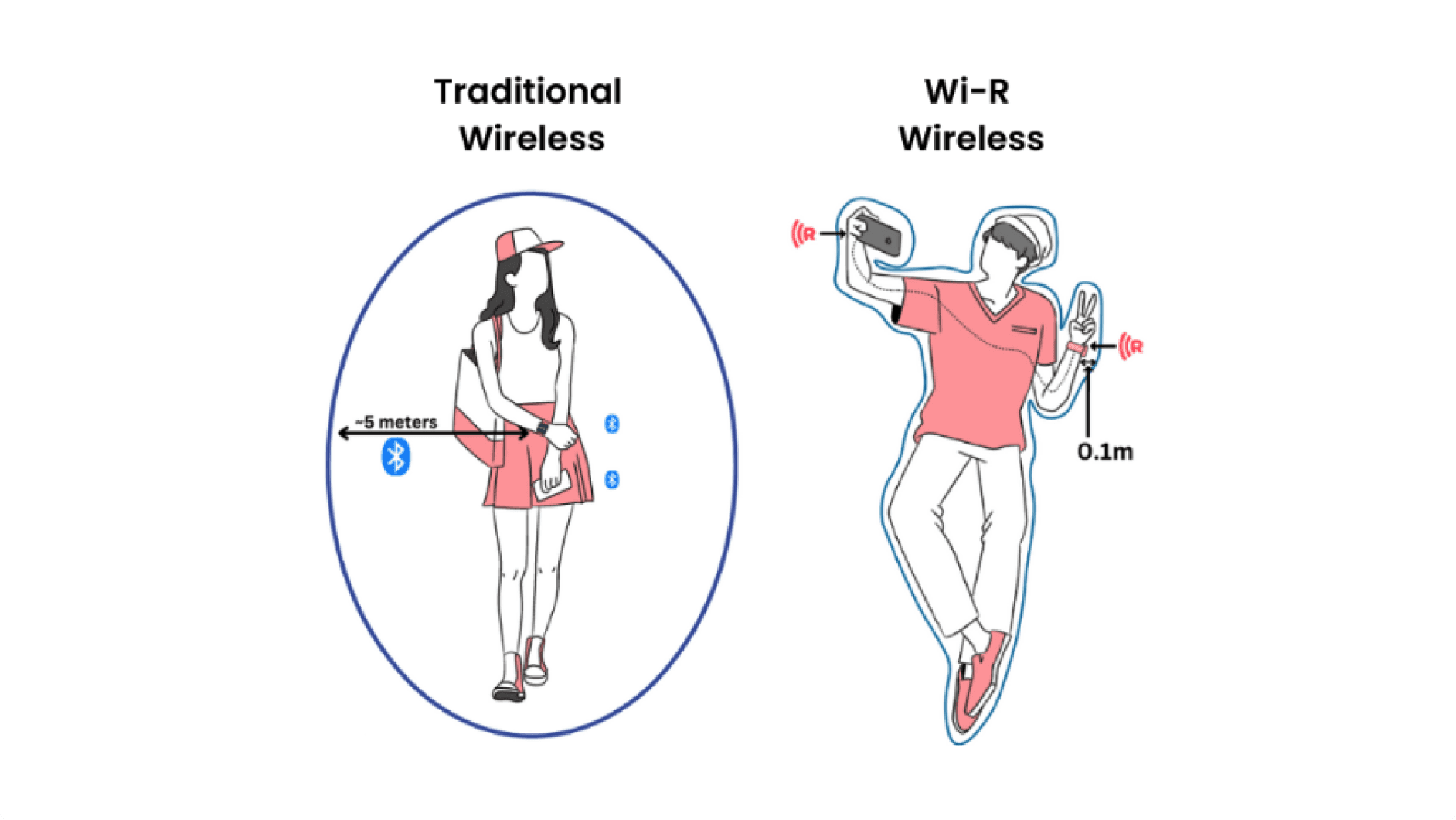
Traditional electromagnetic (EM) field-based wireless systems such as Bluetooth, Wi-Fi, or UltraWideBand (UWB) radiate signals in every direction. For example, Bluetooth signals can be accessed by anyone in a 5-10 m radius. Wi-R, on the other hand, confines the signal around the surface, similar to wired communication. Someone sitting a row next to you does not even have access to the physical signal, leading to energy efficiency and additional physical security on top of the mathematical security that comes from encryption.
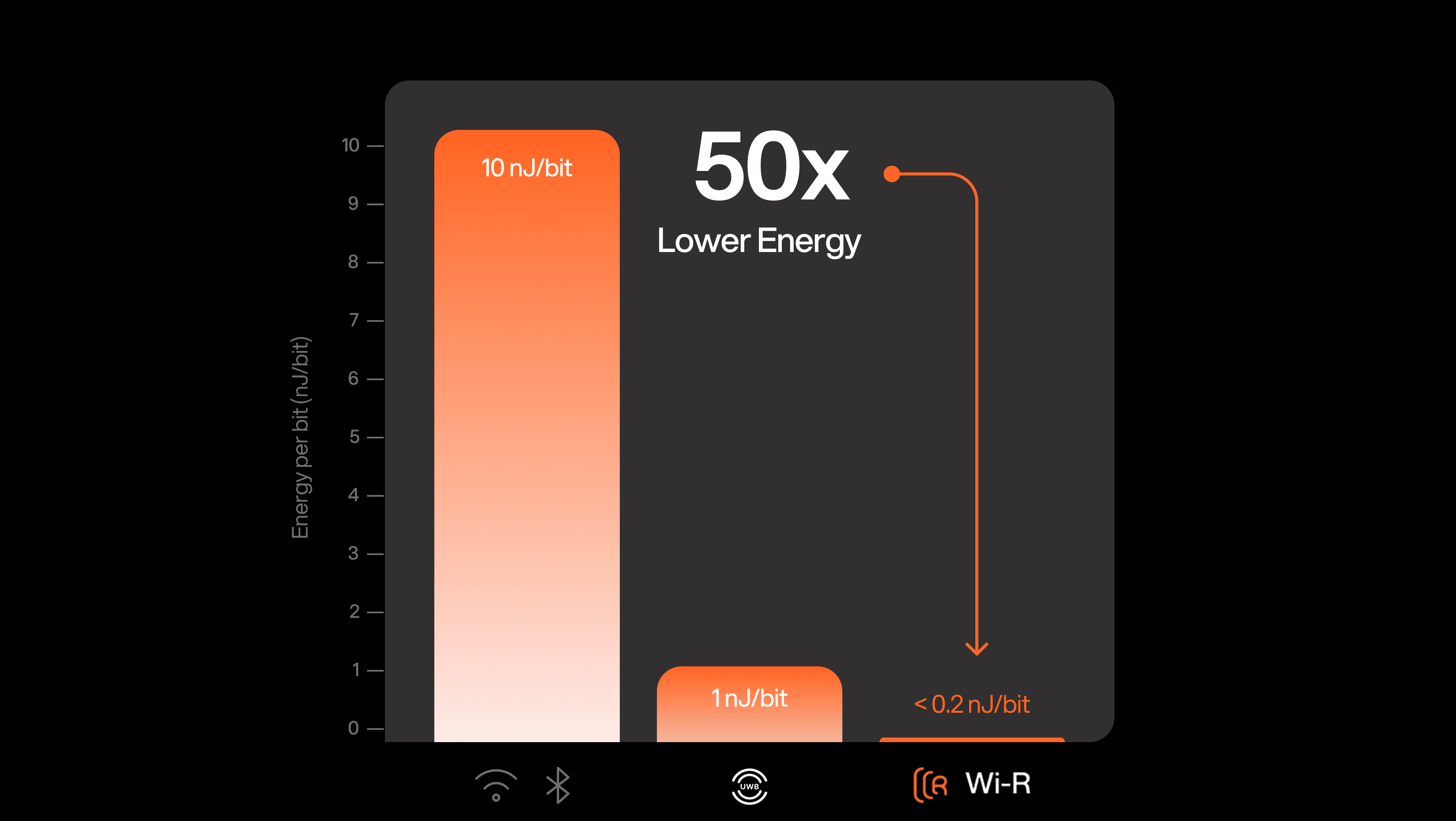
50x more Energy-Efficient than Traditional Wireless
The use of EQS fields, combined with proprietary techniques developed by Ixana, enables communication at 100x lower energy than Wi-Fi or Bluetooth (around 10 nJ/bit), and over 10x lower energy than UWB (>1 nJ/bit). The inspiration for Wi-R comes from wired communication (for example, USB-C) where ultra-low energy (~1 pJ/bit) is commonplace. However, the personal area network (PAN) channels utilizing EM waves, such as Bluetooth and Wi-Fi, do not at all look like broadband channels. The key patented invention enabling Wi-R is the ability to develop a broadband channel for the personal area network, enabling wire-like energy efficiencies.
Wi-R is your Personal Secure Broadband solving the "last-meter problem" in Body Area Network (BAN)
For Human-Computer Interaction (HCI), and many other applications of augmented humans, there is a need to connect one or many devices on the human to a central hub on the human. Connecting each device with an off-human router individually is extremely energy-inefficient and reduces channel capacity due to co-existence issues among devices on the same human as well as interactions among devices on multiple humans.
Moreover, there is a privacy issue as sensitive data can be snooped from up to 10 m away. Wi-R solves these problems by creating an EQS bubble near the surface (<10 cm) that is private and high-speed. Current prototypes work up to 1 Mb/s (good enough for music and images) and up to 20 Mb/s prototypes (for video) are under development.
How does Wi-R compare with other Near-field communication techniques?
The prominent near-field communication products available in the market are NFC and NFMI. Near-Field Communication (NFC) is an extremely short-range communication method typically used for payment. Near-Field Magnetic Induction (NFMI) is a longer-range version of NFC and has been commonly used for connecting one earbud to another for relaying audio for synchronous playback in both ears.
Both NFC and NFMI use Magneto-Quasistatic (MQS) fields, creating a magnetic bubble for communication. They circulate current in an inductor or coil to create magnetic fields that are picked up by another coupled inductor or coil nearby. Humans being transparent to magnetic fields does not provide any particular advantage limiting the range to a few cm for NFC and creating high channel loss for longer distances for NFMI. Moreover, the range is similar between the human as well as away from the human. Finally, to obtain low channel loss often these MQS techniques need to use resonance, which leads to narrowband channels and hence low data rates (~600 Kbps in NFMI) and higher energy (~5 nJ/b).
Conversely, Wi-R can be thought of as the dual of NFMI, which utilizes tiny amounts of EQS fields and benefits from moderate conductivity and high permittivity of a structure to confine the signal on the conducting structure, i.e., the signals are present throughout the structure but not away from it. This also leads to the ability to create broadband or wideband channels, leading to high data rates (up to 20 Mb/s) and extreme energy efficiency (<0.1 nJ/b).
What does Wi-R enable that is not possible today?
Wi-R’s transformative capabilities enable applications that are limited only by designer imagination (and physics). Some of the prominent features are:
- Combine touch, intent, and communication in a single seamless action
- Simplified pairing for smart devices: user-initiated touch-based pairing reduces setup friction
- Touch selectivity: transfer contacts with a fist bump
- Multiple time-synchronized wearables: imagine up to 25 body motion trackers
- Ultra-low-energy: all-day, real-time, distributed AI
- High-speed: stream video from AR headset to smartphone
- Physically secure: additional layer of security for sensitive data or action
- Negligible inter-human interference: increases capacity of communication in a space with multiple humans, each with multiple wearables
- Charging-free patches: sensing energy is typically low for many applications. Communication energy and peak power requirements are typically the bottleneck. Wi-R opens the door for long-lasting and even charging-free patches for many low-speed applications by lowering the communication energy by 100x
- Distributed computing in BAN: augmenting humans with real-time AI
Why has similar technology not been used before?
While there have been BAN and PAN working groups and much research on human body communication, most approaches tried to bring traditional wireless radio techniques to solve this problem, limiting the benefits attainable from these approaches. Especially, using radio-like techniques with EQS fields made the channel loss prohibitively high.
Radios were invented to communicate in a vacuum and over the air. However, they are not the most efficient when trying to conduct over a conducting high permittivity structure such as the human body, suffering from RF signal absorption and heating in some cases.
Realizing this unique nature of communication required leveraging a conducting structure with high permittivity. Given Dr. Shreyas Sen’s unique background in both the Wireless and Wireline IO industry, he and his team brought a fresh take to solving the problem by utilizing EQS fields and creating a wire-like wireless channel that is fundamental to the achievable benefits.
The first concept came out in 2016 and the first detailed demonstration of the technology happened in 2019. Ixana is the first and only company to bring this transformative technology to market. We believe Wi-R is a pivotal moment for BAN and PAN.
AIApplicationAugmented RealityDistributed computingWearables

Shreyas Sen
Elmore Associate Professor of ECE & BME at Purdue, Founder & CTO of Ixana, MIT TR35, TEDx, GT 40U40
Illustrative use case only. This page describes example workflows and interoperability concepts involving Ixana Wi‑R technology and third-party systems. Unless expressly stated otherwise, Ixana provides communications silicon, circuit boards and firmware components for E-field based body-area-network and near-field data transfer and is not offering complete medical device, clinical triage system, or finished end products.