Jun 5, 2026Ixana Team8 min read
Portless Service for Sealed Automotive Modules | Ixana Wi-R NFE
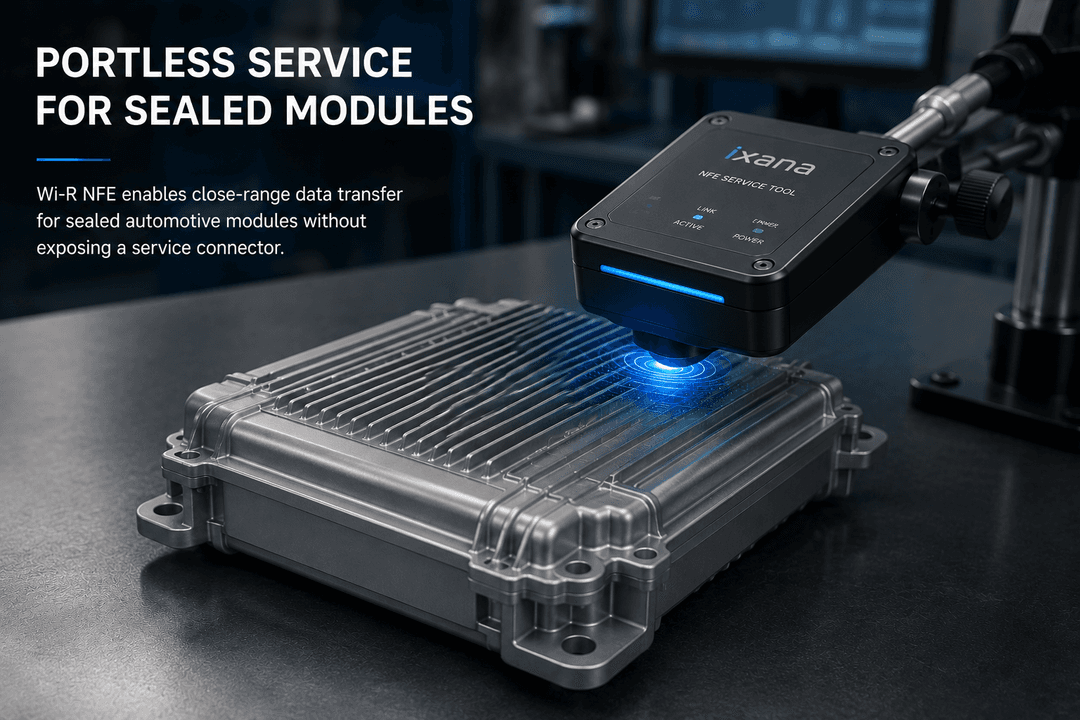
How Wi-R NFE enables portless service for sealed automotive ECUs and ADAS modules: provisioning, diagnostics, and calibration without opening the case.
Portless Service for Sealed Automotive Modules: A Practical Evaluation Path for Wi-R NFE
by Shreyas Sen
Automotive does not need another wireless manifesto. It needs a better way to service sealed electronics.
Across ECUs, ADAS cameras, radar modules, sensor pods, and other edge electronics, sealing is becoming part of the product strategy. It can improve durability, tamper resistance, corrosion protection, and industrial design. But sealing also creates a practical problem: software still has to be provisioned, logs still have to be pulled, calibration still has to happen, and service teams still need a reliable local path into the module.
That is the first automotive wedge for Ixana's Wi-R NFE: not vehicle-wide wireless, not a replacement for established diagnostic infrastructure, and not a broad platform claim.
Wi-R NFE is a close-range, physically local data link designed for portless provisioning, service, and data offload. For sealed automotive modules, the opportunity is straightforward: when the enclosure is closed, can a local near-field service path replace the exposed connector, pogo-pin contact, or unnecessary broader RF interaction for a specific workflow?
That is a practical question. It is measurable. And it is the right way to evaluate a new connectivity primitive in automotive.
The last connector problem
Modern vehicles are becoming more software-defined, but software-defined does not mean connector-free by default. Every sealed electronic module still creates a question for manufacturing, service, and rework teams: how do we provision it, update it, validate it, and recover data from it after the enclosure is closed?
Historically, the answer has often been a service connector, pogo-pin access, fixture contact, or conventional wireless link. Each option has tradeoffs.
Physical connectors and contacts add mechanical exposure, wear paths, corrosion risk, and packaging constraints. Broader wireless links can add pairing friction, coexistence work, and unnecessary spatial reach for a workflow that is supposed to happen at the module boundary.
Wi-R NFE is built for the narrow space between those options: close-range, intentional, local data transfer for sealed devices and equipment. In automotive, that makes it especially relevant for service interactions where the tool is already near the module and the goal is to move meaningful data without reopening the packaging problem.
Complementary to existing diagnostics
For automotive teams, precision matters. Wi-R NFE should not be positioned as a replacement for regulated vehicle-level diagnostic access or the broader diagnostic architecture already present in the vehicle.
The more credible first fit is module-boundary service: factory provisioning, rework-station reflashing, local log offload, sealed-module diagnostics, and ADAS sensor calibration where the interaction is physical, intentional, and close-range.
This framing matters because it keeps the first evaluation bounded. Instead of asking an OEM or Tier 1 to rethink service infrastructure, Wi-R NFE asks a narrower question: can one sealed-module workflow be made simpler, faster, or more robust by replacing an exposed service interface with a local portless data link?
That is the right starting point.
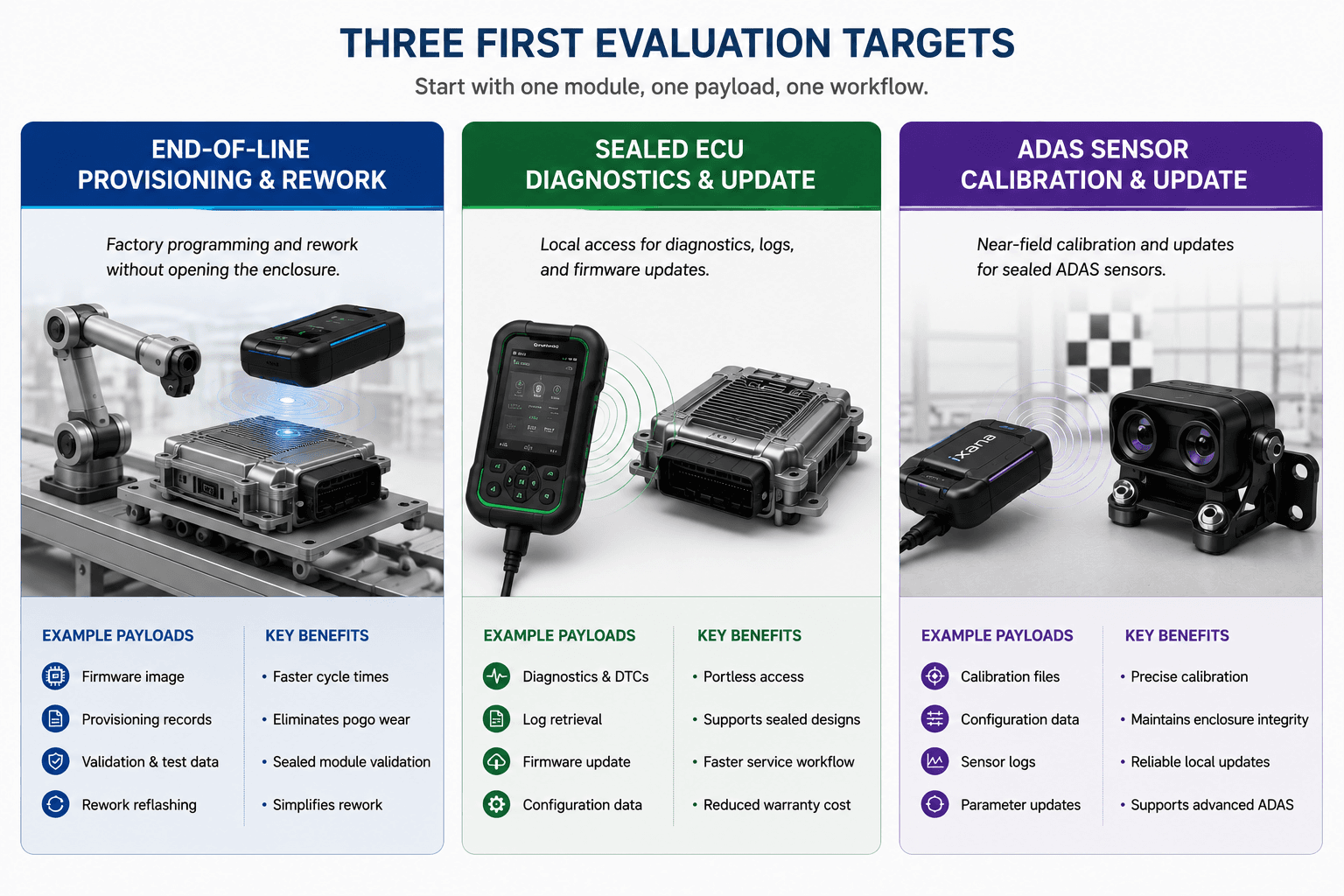
Three workflows worth evaluating first
1. End-of-line provisioning and rework
Manufacturing is often the cleanest place to evaluate a new interface. The module is known. The fixture is controlled. The payload is measurable. The time budget is explicit.
A portless near-field link can be evaluated against practical production questions: can it move the real image within the takt-time or rework-time budget? Can it reduce dependence on exposed contacts or pogo pins? Can it support sealed-module validation after final enclosure? Can it simplify rework without compromising the mechanical design?
Ixana's published XA-NFE3001 examples show typical goodput sufficient for meaningful service payloads: roughly 25 MB in about 15 seconds, 50 MB in about 30 seconds, and 100 MB in about 59 seconds. Those are not abstract data-rate claims; they are workflow-level numbers that manufacturing and rework teams can test against real process requirements.
For many teams, this is the lowest-risk first pilot: one fixture, one module, one payload, one time budget.
2. Sealed ECU diagnostics and firmware update
A sealed ECU still needs local access. Service teams may need to read diagnostics, retrieve logs, push firmware, validate configuration, or recover data from a module without adding another exposed connector to the enclosure.
That makes sealed ECU service a natural evaluation candidate for Wi-R NFE.
The goal is not to make every diagnostic workflow portless. The goal is to determine whether a specific sealed module can keep its enclosure strategy while still supporting practical local service access.
A strong first test would use the actual ECU housing, the expected service-tool geometry, the real payload, and the intended powered state. The output should be a clear go/no-go decision: does the portless link improve the service workflow enough to justify further integration work?
3. Near-field ADAS sensor calibration and update
ADAS modules are another strong fit because the workflow is already local. A factory station, service tool, or calibration fixture is positioned near the camera, radar, or sensor module. The interaction is deliberate. The payload may include calibration data, configuration data, diagnostic logs, or software.
For this class of module, the packaging team may not want to preserve an exposed cable port solely for occasional service access. Wi-R NFE creates a possible alternative: a local data path at the module boundary that can be evaluated without turning the conversation into a vehicle-wide network decision.
The question is practical: can the tool move the required data through the actual housing and stack-up, within the service time budget, with acceptable alignment tolerance?
Evaluate through the real module, not a simplified demo
A serious automotive evaluation should look less like a lab demo and more like an engineering decision.
Start with one sealed module. Use the real housing. Use the actual stack-up. Use the real payload. Use the expected service-tool geometry. Then test whether Wi-R NFE improves the workflow enough to justify the next phase.
The first evaluation should answer six questions.
Can the link move the real payload inside the real time budget? Benchmark the actual firmware image, logs, calibration files, provisioning data, security artifacts, and post-update validation records. Published throughput examples are a starting point; the production workflow decides whether the link is fast enough.
Can it couple through the real enclosure? Test the actual housing, coatings, adhesives, gaskets, brackets, shields, thermal paths, grounding features, and mechanical stack-up. Near-field behavior depends on the complete mechanical and electrical design, not just the chip.
What are the alignment and handling limits? A production fixture or technician tool needs tolerance. Measure distance, angle, position repeatability, technician handling variation, fixture wear, contamination, and environmental exposure.
What powered state does the workflow require? Define whether the target module is fully powered, fixture-powered, asleep, partially powered, or in a recovery state. This matters for firmware update, log retrieval, and failed-update recovery workflows.
How does the link fit the cybersecurity model? A physically local link can reduce spatial exposure, but proximity is not a complete security architecture. Automotive service workflows still need authentication, authorization, signed payloads, anti-rollback behavior, audit logging, and interrupted-update recovery.
What is the validation path? Any production-intent use case has to fit the normal automotive validation environment, including EMC, coexistence, ESD, temperature, reliability, change control, and qualification planning. Those questions do not need to be solved before a first bench evaluation, but they should be visible from the beginning.
This is the level of rigor that makes a new interface credible to automotive teams.
Why this is a semiconductor evaluation, not a finished-system claim
Ixana provides the connectivity building blocks: communications silicon, circuit boards, and firmware components for E-field-based connectivity. The automotive system design, service workflow, cybersecurity architecture, diagnostic process, and production validation remain OEM- and Tier 1-specific.
That distinction matters.
A sealed-module service link does not become production-ready because a chip can move data across a bench setup. It becomes interesting when the link can be evaluated inside a real module, with a real service tool, under real packaging, security, and validation constraints.
That is the evaluation Wi-R NFE is designed to support.
One module. One payload. One workflow.
A practical first engagement should not begin with a platform decision. It should begin with a module-boundary problem.
Bring one sealed module stack-up. Bring one payload size. Bring one service-time budget. Bring the expected powered state and intended service-tool geometry. Ixana can then help assess whether Wi-R NFE is a fit for a portless service evaluation.
A strong first pilot might look like this:
- Module: sealed ECU, ADAS camera, radar module, sensor pod, or control module
- Workflow: end-of-line provisioning, rework reflashing, local diagnostics, log offload, or calibration update
- Payload: firmware image, calibration file, diagnostic log bundle, provisioning record, or validation data
- Success metric: transfer time, alignment tolerance, housing compatibility, recovery behavior, and integration complexity
- Decision: continue to a design-in study, refine the mechanical/electrical implementation, or stop early
That is how new automotive interfaces earn credibility: not by claiming to change the whole vehicle, but by solving one high-friction workflow better than the current method.
Ready to evaluate Wi-R NFE for a sealed module? Schedule a Sealed-Module Design Session to bring your module housing stack-up, payload size, powered-state assumptions, service-tool geometry, and time budget — Ixana will help assess whether Wi-R NFE fits a portless service evaluation.
To start hands-on testing of coupling, throughput, alignment tolerance, and enclosure behavior in your own module architecture, request the NFE Dev Kit.
AutomotiveWi-R NFEADASEmbedded SystemsIoT

Ixana Team
Developing ultra-low-power near-field wireless technology for the next generation of mobile and wearable devices.
Illustrative use case only. This page describes example workflows and interoperability concepts involving Ixana Wi‑R technology and third-party systems. Unless expressly stated otherwise, Ixana provides communications silicon, circuit boards and firmware components for E-field based body-area-network and near-field data transfer and is not offering complete medical device, clinical triage system, or finished end products.