Sep 29, 2026Ixana Team7 min read
The Impossible Trinity of AI Glasses: Performance, Battery Life, and All-Day Comfort
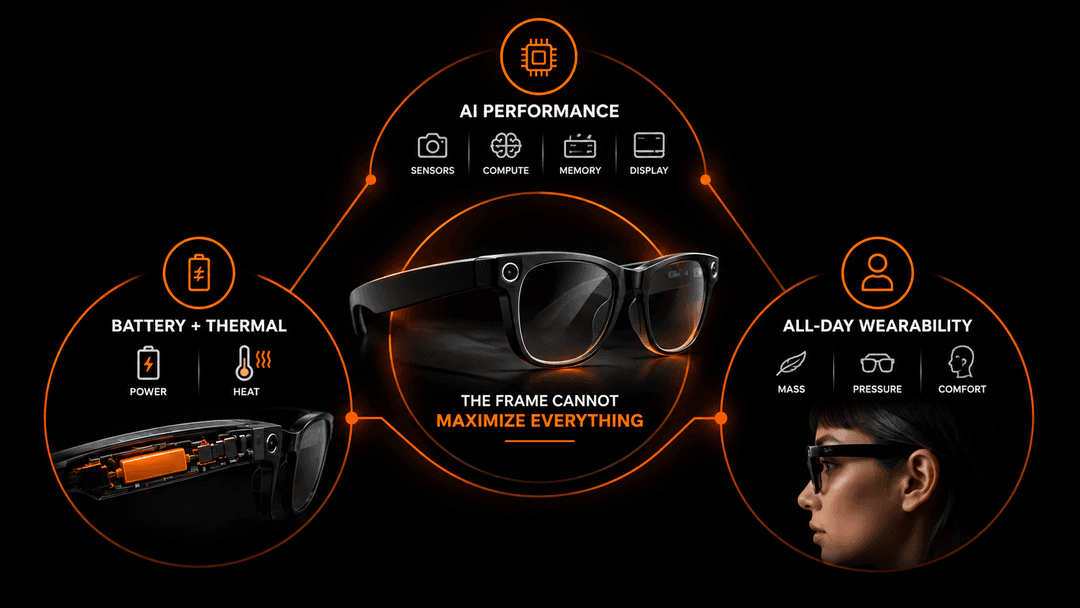
Glasses that can be worn all day are not necessarily glasses that can run AI all day. Why performance, battery life, and comfort form an impossible trinity, and how Wi-R changes the design space.
AI GLASSES / SYSTEM ARCHITECTURE
The Impossible Trinity of AI Glasses: Performance, Battery Life, and All-Day Comfort
Glasses that can be worn all day are not necessarily glasses that can run AI all day.
Most current AI-glasses interactions are brief: taking a photo, translating a sign, answering a question, or showing the next navigation cue. Between interactions, parts of the system can return to lower-power states.
Continuous AI workloads change the design problem. Sensors, processors, displays, and wireless links may need to operate frequently or for sustained periods, making power, heat, weight, and comfort one coupled system constraint.
Why the tradeoff is structural
This is the impossible trinity of AI glasses: useful AI performance, a workable battery and thermal envelope, and all-day wearability. Eyewear-class hardware sharply constrains battery capacity and heat spreading, while comfort depends on total mass and weight distribution [1, 2]. System designers therefore have to decide not only what to compute, but where to compute it.
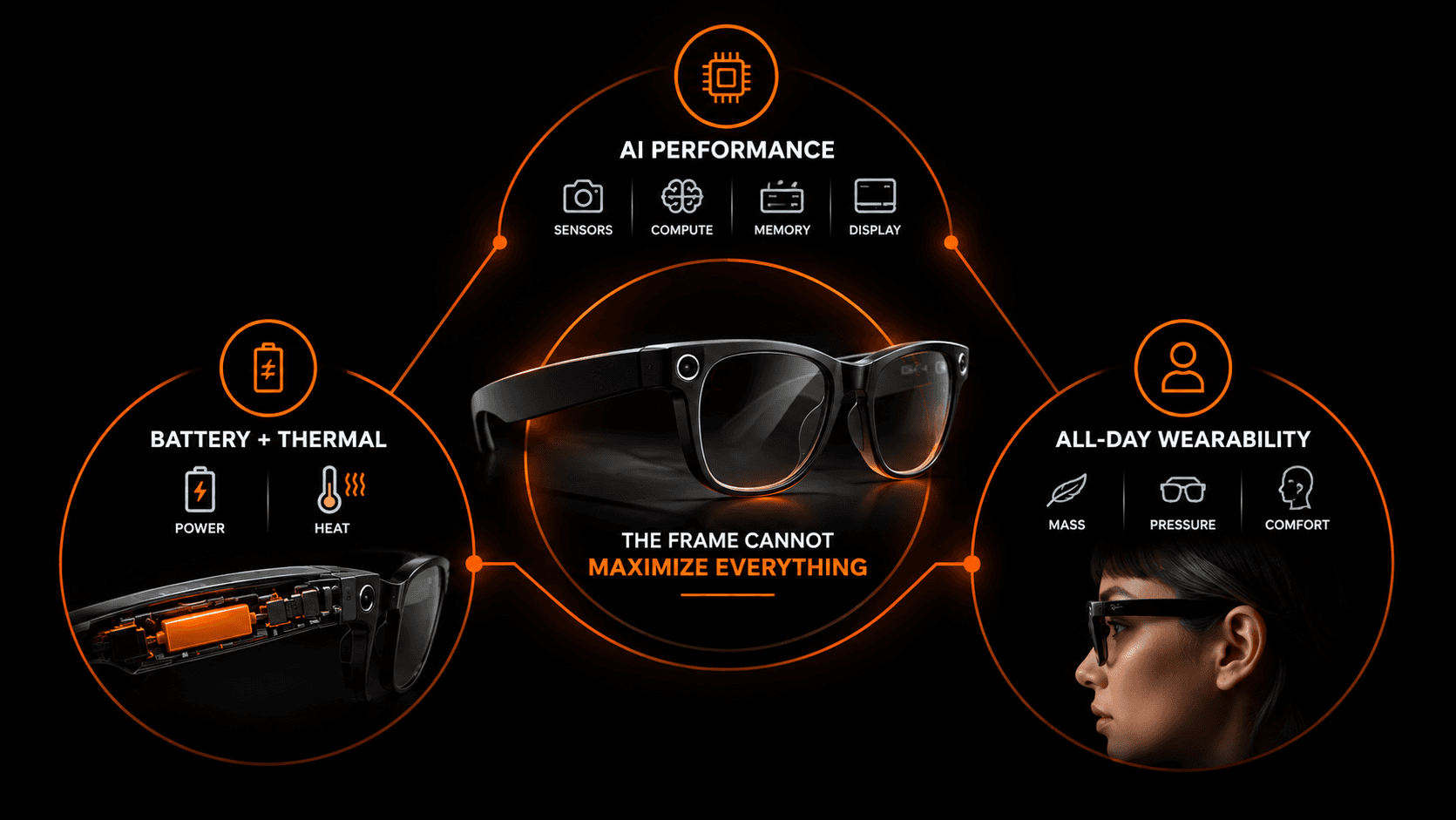
The three constraints cannot all be maximized inside one eyewear-class frame.
"All-day" is a workload, not a battery spec
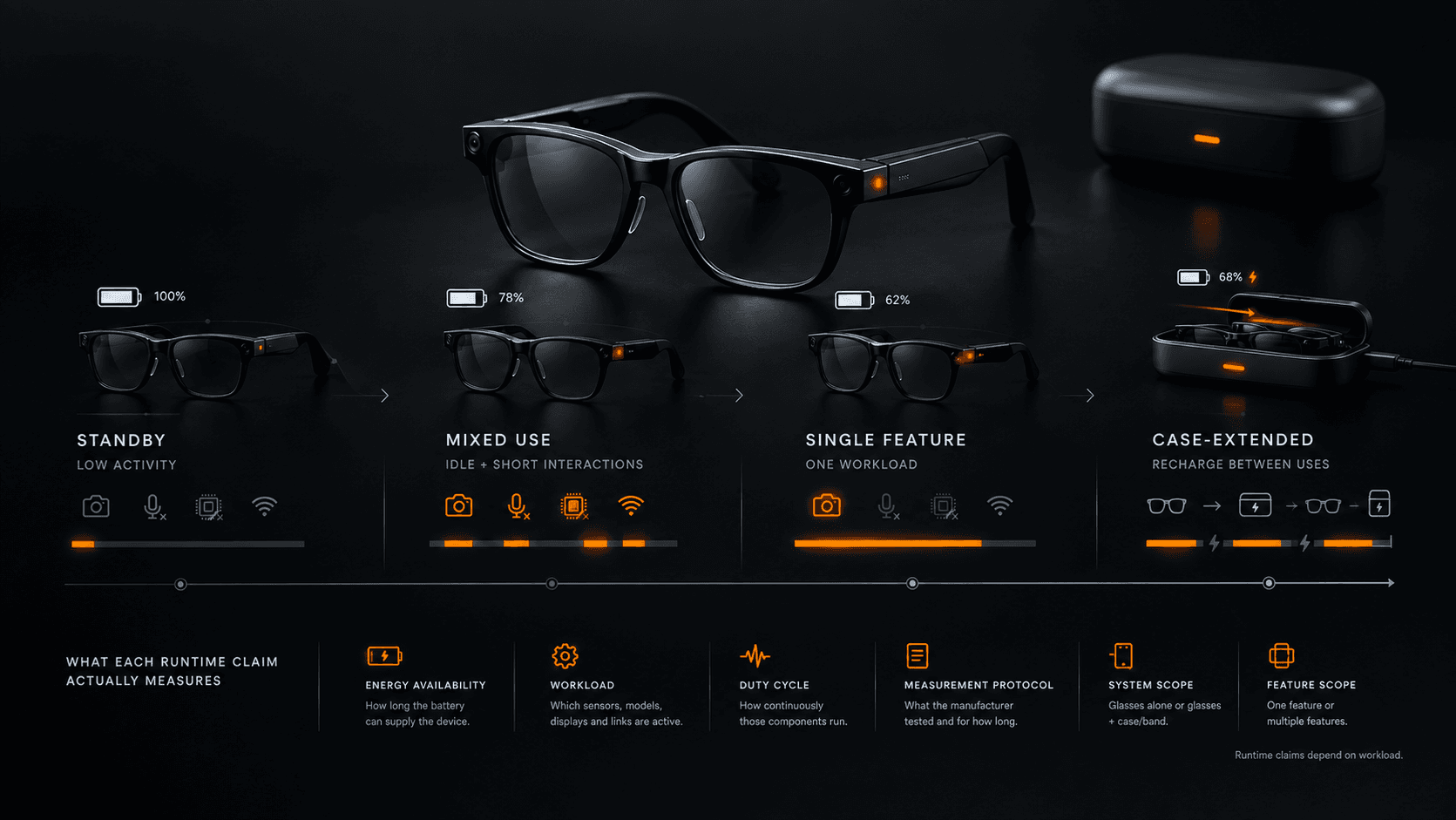
Battery-life claims only mean something in the context of the workload behind them. Meta's Ray-Ban Display glasses illustrate this: they're rated for up to six hours of mixed use, while the companion Neural Band carries a separate 18-hour rating [1]. Neither figure by itself confirms all-day continuous AI operation.
The industry is already distributing the system
One way to reduce what the frame must carry is to distribute the workload. Lightweight functions can remain in the glasses, especially those sensitive to latency, privacy, or immediate feedback, while heavier processing moves to a nearby device or the cloud. Qualcomm distributes processing across components and a compatible host [3]. Sony's IMX500 can perform supported AI processing in the image sensor [4]. Meta distributes interaction across its glasses and a separate companion input device [5].
The common pattern is that designers are deciding where a function should live, rather than assuming every function belongs in the glasses.
How industry architectures approach the tradeoff
The industry is already experimenting with different architectural choices; each protects some constraints and accepts tradeoffs elsewhere:
| Platform | Approach | Constraint it protects | Cost moved elsewhere |
|---|---|---|---|
| Qualcomm AR2 Gen 1 | Processing distributed across an AR processor, co-processor, connectivity platform, and compatible host | More compute without placing every function in one component | More integration complexity and multi-component hardware |
| Sony IMX500 | Supported AI processing in the image sensor | Can reduce unnecessary image-data movement for specific vision workloads | Limited to workloads supported by the sensor and its processing envelope |
| Meta Ray-Ban Display and Meta Neural Band | Interaction distributed across glasses and a separate companion input device | Moves some interaction functions outside the glasses | Adds another device, battery, and link |
These architectures make different product choices, but they share one principle: workload placement is a system decision. Sensing, interaction, inference, storage, and connectivity do not all have to live in the same enclosure.
Offloading moves part of the constraint to the link
Offloading only pays off when the compute energy saved on the glasses exceeds the energy spent preparing, sending, and receiving the data:
Eavoided, frame > Eprep + ETX + ERX + Eprotocol
-
Eavoided, frame: computation avoided in the glasses
-
Eprep: filtering, compression, packetization, and serialization
-
ETX: energy used to send data
-
ERX: energy used to receive results or control data
-
Eprotocol: wake-up, scheduling, idle, contention, and retransmission costs
Offloading creates battery and thermal headroom in the glasses only when the local computation avoided exceeds the communication cost incurred by the glasses. This is a frame-side condition, not a claim that offloading always reduces total energy across the complete system.
Frequent or sustained data transfer consumes energy in the same constrained system as sensing and compute. The link therefore becomes part of the AI architecture, not merely a connectivity feature.
Why Wi-R changes the design space
Wi-R connects Wi-R-enabled wearable devices through a localized electric-field channel. It is designed for low-energy, low-latency data movement between nearby endpoints, so sensing, compute, and interaction do not have to live in one enclosure.
At 5 Mbit/s, approximately 0.2 nJ/bit corresponds to about 1 mW of active communication power. Whether offloading creates a net frame-side benefit still depends on preprocessing, protocol overhead, and the computation avoided.
| Proof point | Result |
|---|---|
| Communication energy | ~0.2 nJ/bit at 5 Mbit/s |
| Active communication power | ~1 mW at 5 Mbit/s |
| Energy-per-bit comparison | 38× lower vs. the identified Nordic nRF54L15 BLE 2M operating point |
| Shipping silicon | 5 Mbit/s available for customer integration |
| Smart-glasses prototype | 480p, 15 fps, monochrome continuous video |
Energy comparison is between identified silicon operating points, not complete-product battery life. Prototype performance depends on the full system architecture.
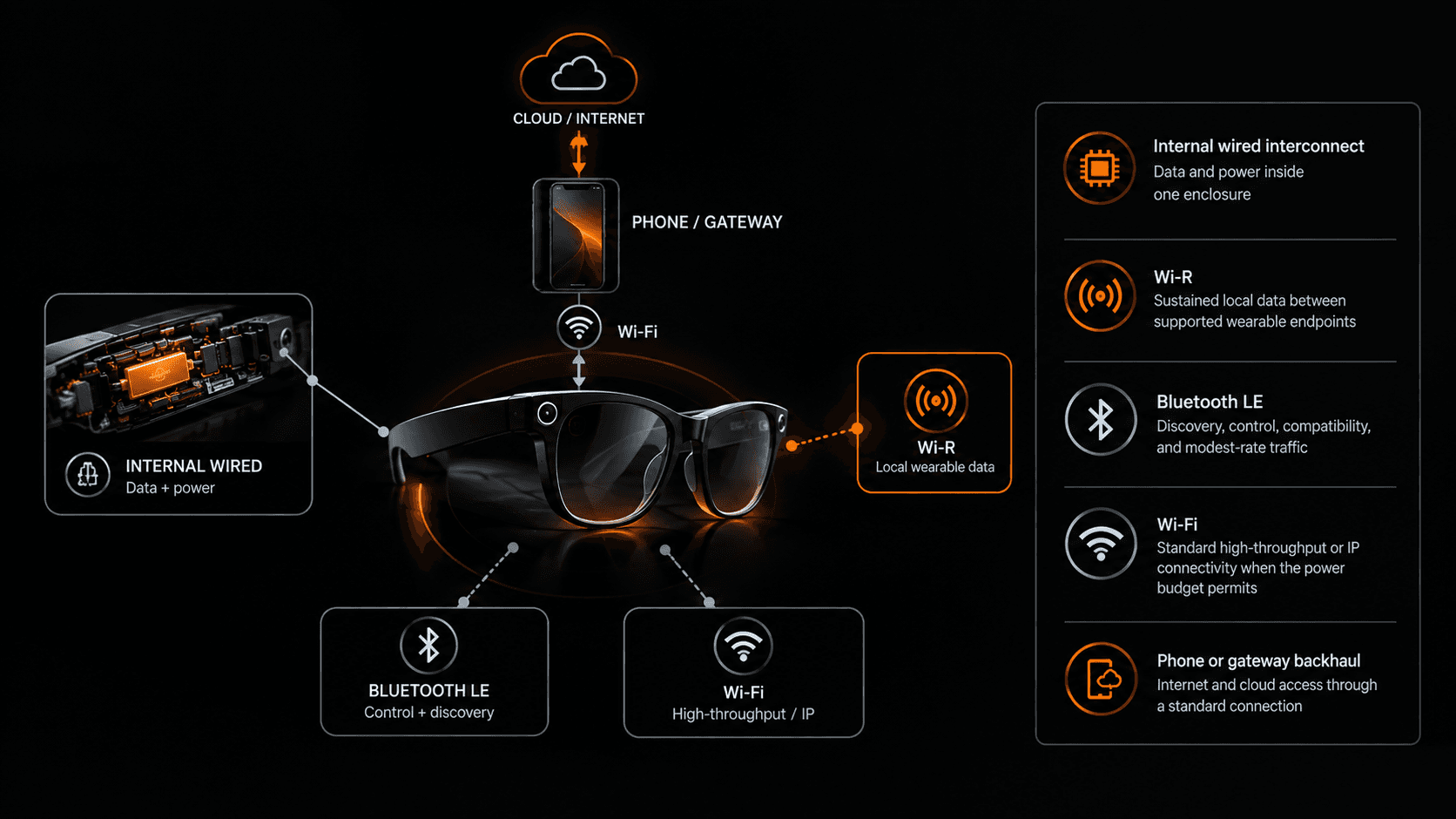
Wi-R is not intended to replace every connection in the system. Bluetooth LE remains valuable for discovery, control, and ecosystem compatibility. Wi-Fi provides standard high-throughput and IP connectivity when the power budget permits it. A phone or another gateway can provide internet and cloud access. Wi-R is designed for the sustained local connection between supported endpoints inside the distributed wearable system.
Each participating endpoint requires Wi-R integration.
One system can use more than one connection
What this changes for AI glasses
With an efficient local interconnect, glasses can keep sensing, filtering, and immediate feedback close to the frame while sending heavier workloads to nearby compute. The cloud can remain available for large models and broad retrieval when latency and connectivity permit it. The three constraints remain impossible to maximize inside one frame. A distributed architecture changes how much sensing, compute, communication, battery, and heat the glasses themselves must carry.
The future of AI glasses is not necessarily a smarter pair of glasses. It is a smarter system around the glasses.
Frequently Asked Questions
What is the impossible trinity in AI glasses?
It is the tradeoff among useful AI performance, a workable battery and thermal envelope, and all-day wearability. Increasing sustained sensing or compute usually increases power and heat, while adding battery capacity affects mass and volume.
Why does mixed-use battery life not establish all-day AI?
Mixed use usually combines idle periods with short interactions. Continuous translation, perception, display operation, or data transfer can create a substantially different power profile. Runtime therefore needs to be tied to a defined workload.
Does offloading AI always reduce power in the glasses?
No. It helps only when the computation avoided in the glasses costs more energy than preparing, transmitting, and receiving the required data, including protocol overhead.
Why does the local link matter?
Once computation is distributed, data must move between sensors and compute frequently enough to support the application. The link then shares the same limited power and thermal budget as sensing and processing.
Does Wi-R replace Bluetooth or Wi-Fi?
No. Bluetooth remains useful for discovery, control, and compatibility, while Wi-Fi provides standard high-throughput and IP connectivity. Wi-R is designed for low-energy local data movement between Wi-R-enabled endpoints within a distributed wearable system.
Sources and Further Reading
-
Yong Min Kim, Sangwoo Bahn, and Myung Hwan Yun, "Wearing comfort and perceived heaviness of smart glasses," Human Factors and Ergonomics in Manufacturing & Service Industries, 31(5), 484–495, 2021.
-
Yujia Du et al., "A comfort analysis of AR glasses on physical load during long-term wearing," Ergonomics, 66(9), 1325–1339, 2023.
-
Qualcomm, "Snapdragon AR2 Gen 1 Platform," official platform documentation.
-
Sony Semiconductor Solutions, "IMX500 Intelligent Vision Sensor," product documentation.
-
Meta, "Meta Ray-Ban Display: AI Glasses With an EMG Wristband," 2025.
-
Ixana, "Wi-R BAN: Ultra-Low Power Wi-R technology overview," technical/product material.
-
Ixana, "YR23 and YR31 Wi-R BAN Transceiver Chipsets," official product-line material.
Wi-RAI GlassesSystem ArchitectureApplicationsWearables

Ixana Team
Developing ultra-low-power near-field wireless technology for the next generation of mobile and wearable devices
Illustrative use case only. This page describes example workflows and interoperability concepts involving Ixana Wi‑R technology and third-party systems. Unless expressly stated otherwise, Ixana provides communications silicon, circuit boards and firmware components for E-field based body-area-network and near-field data transfer and is not offering complete medical device, clinical triage system, or finished end products.